
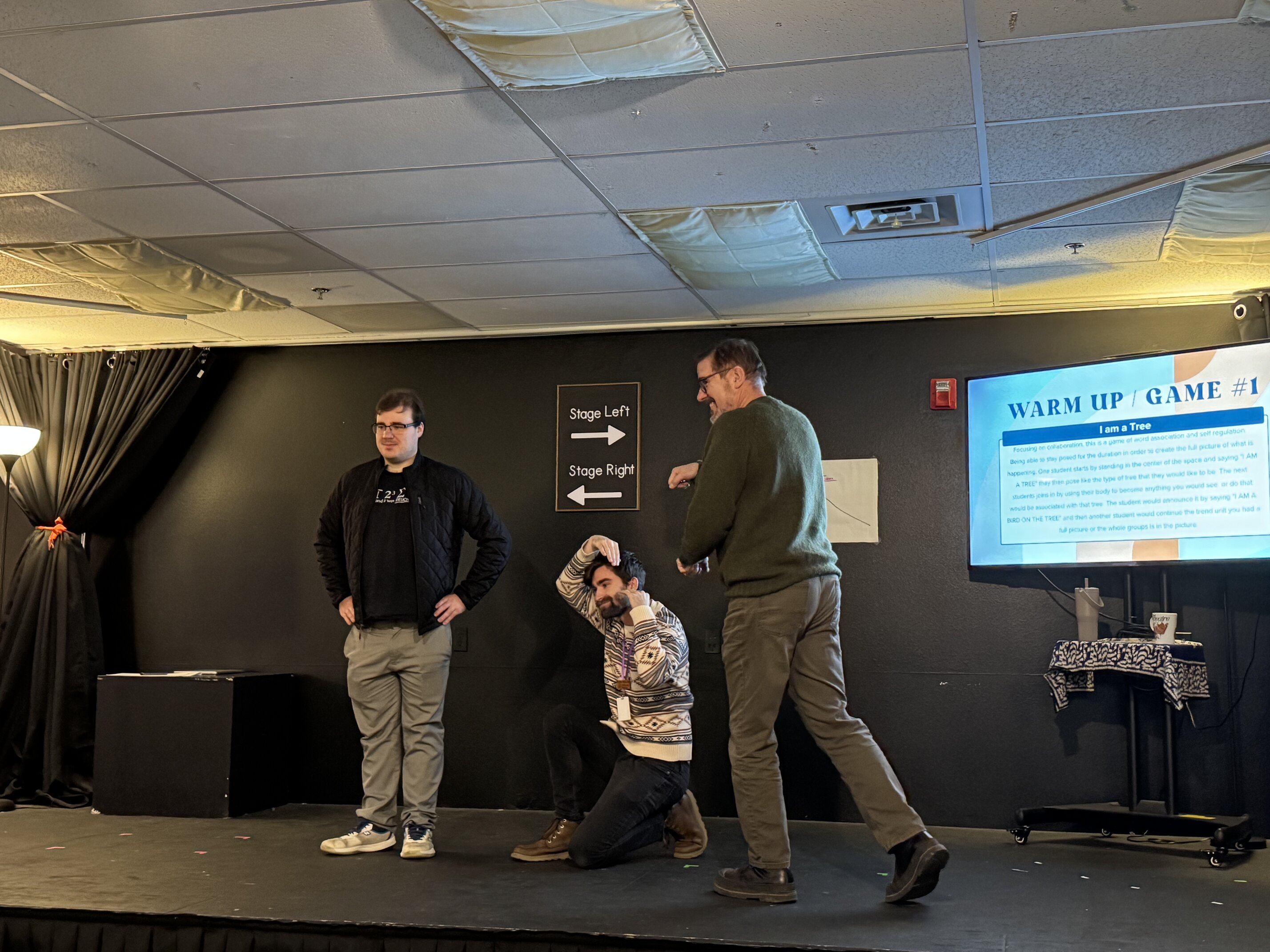
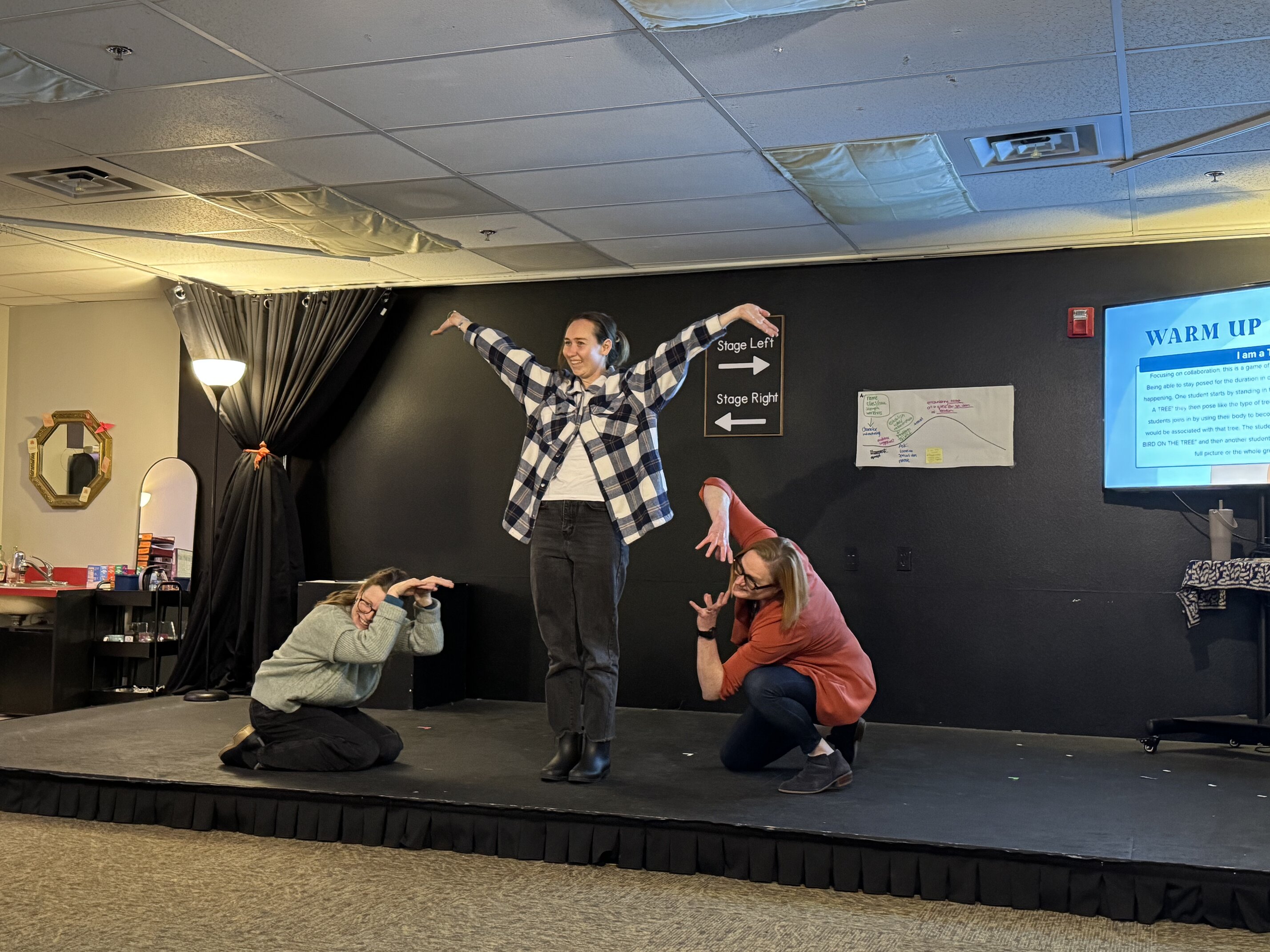
At its core, improvisation is not about performance — it’s about presence. This month, our Learning Specialist partnered with our Performing Arts instructor to lead a professional development training in improv. Together, they invited staff to explore improv as a philosophy for teaching, learning, and connecting, particularly in support of our neurodivergent student population.
Improvisation requires responding flexibly and collaboratively to what is happening in the moment — a practice our teachers already use daily. Students arrive with varied energy and attention levels, emotional states, sensory needs, and ideas that often shift from minute to minute. Effective teaching requires noticing these changes and responding with intention.
A foundational principle of improv, “yes, and,” means first acknowledging what someone says and then building on it to keep the interaction going. As a relational philosophy, this looks like accepting a student as they are (“yes”) and acknowledging their experience, perspective, expertise, and needs, and then building on that with the lessons or activities to further engage students (“and”), creating a collaborative and communal approach to learning.
In the classroom, this approach encourages educators to remain flexible and use intentional language that prioritizes regulation and engagement over correctness. Through this improv-informed philosophy, teachers support students in developing critical skills and building understanding, including interactive, responsive learning where ideas are acknowledged and built upon rather than corrected; engagement without pressure, where participation may look like thinking, observing, listening, or contributing; practice with uncertainty, recognizing that outcomes are not always immediate; shared meaning-making through collaboration; and safety to try, pause, and repair, with mistakes viewed as information rather than failure.
This approach supports cognitive flexibility, builds psychological safety, strengthens engagement, and provides a clear, predictable structure for problem-solving. Students’ creativity is protected, risk-taking is encouraged, and persistence in learning increases.
Our staff are already putting this training into practice, both in the classroom and in building rapport outside of it. When one student struggled to engage at school, our counselor leveraged another teacher’s need to invite the student to participate in a unique way. The student was energized by the task and experienced less friction transitioning into class afterward.
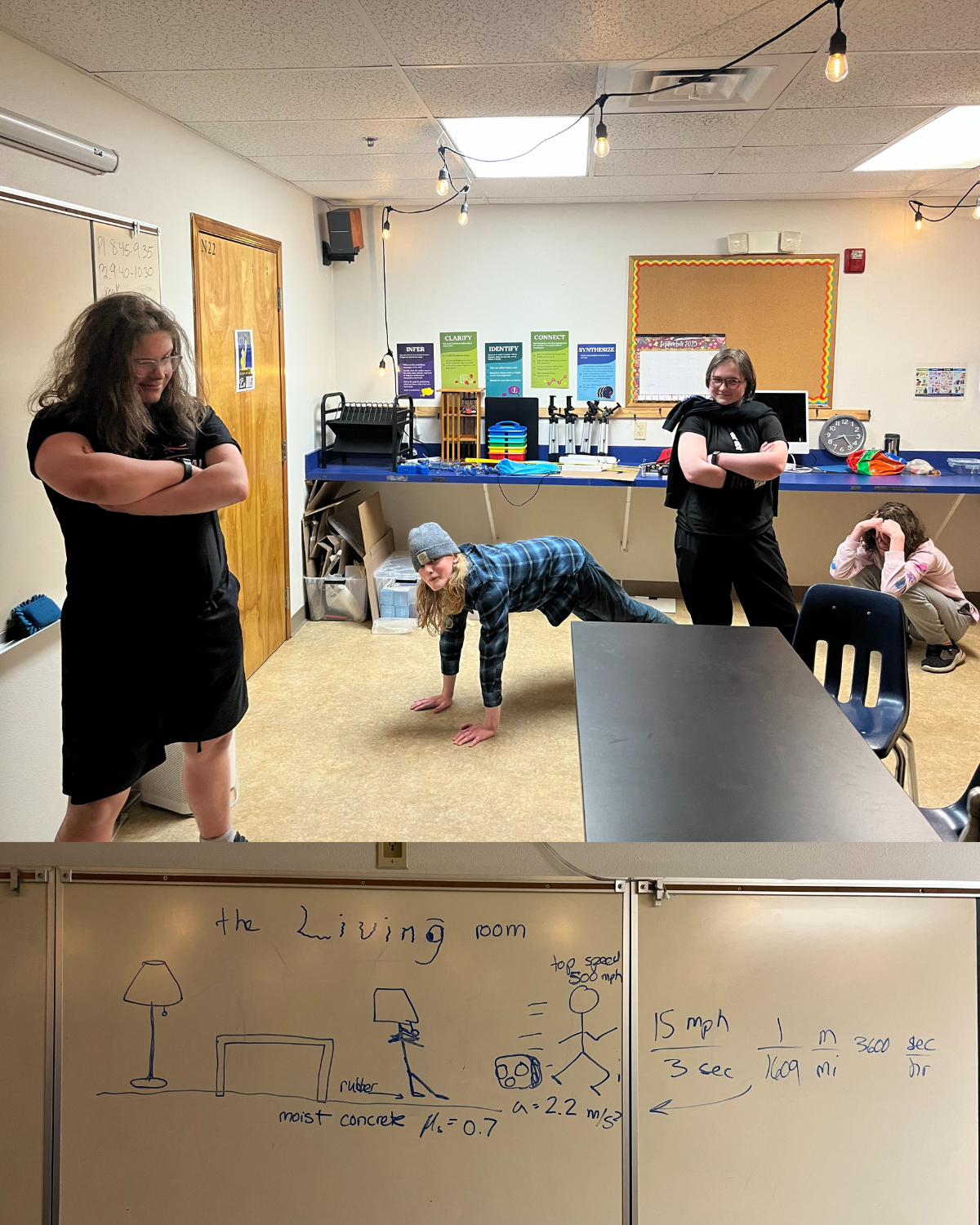
In classrooms, teachers are also integrating improv-informed strategies into their lessons. A biology teacher used a “taxi” activity in which students embodied the characteristics of specific molecules, while classmates made guesses based on their descriptions. She noticed increased participation from students who typically struggle in more traditional classroom formats. In physics, a collaboratively created scene allowed students to creatively shape the lesson. In one instance, a living room transformed into a horror scene where a possessed lamp chased a student through a hallway made of moist concrete. As the scene evolved, students felt a sense of ownership and agency, prompting deeper engagement while covering complex material and reinforcing the idea that physics truly exists everywhere.
Ultimately, improv reframes the classroom as a responsive, relational space. It reminds us that learning happens not only through plans and outcomes, but through trust, adaptability, and the courage to stay present with one another in the moment.
Sources:
Bayne, H. B. & Jangha, A. (2016). Utilizing improvisation to teach empathy skills in counselor education. Counselor Education & Supervision, 55, 250-262.
Berk, R. A., & Trieber, R. H. (2009). Whose classroom is it, anyway? Improvisation as a teaching tool. Journal on Excellence in College Teaching, 20(3), 29-60.
Cenki, A. T. & Roetting, C. (2024). Using improvisational theater to develop emotional intelligence. The International Journal of Pedagogy and Curriculum, 31(2), 115-140.
DeGagné, D. (2022). Trust and go: Enhancing collaborative school cultures through improv. International Journal for Leadership in Learning, 22(1), 117-148.
Mehta, A., Hendel-Paterson, B., Shah, N., Hemphill, J., Adams, N., & Fredrickson, M. (2024). Intelligent play: How improv can improve clinician’s emotional intelligence. The Clinical Teacher, 21, 1-6.
Moshavi, D. (2001). “Yes and...”: Introducing improvisational theater techniques to the management classroom. Journal of Management Education 25(4), 437-449.
Schwenke, D., Dshemuchadse, M., Rasehorn, L., Klarhölter, D., & Scherbaum, S. (2021). Improv to improve: The impact of improvisational theater on creativity, acceptance, and psychological well-being. Journal of Creativity in Mental Health, 16(1), 31-48.
Schwenke, D., Bleichner, M. G., Fjaellingsdal, T. G., Meekes, J., Bogels, S., Kraplin, A., Kuhlen, A. K., Wehner, P., & Scherbaum, S. (2024). Improving by improvising: The impact of improvisational theater, on handling expectation violation during social creativity. Journal of Creativity in Mental Health, 34.
Seppänen, S., Tiippanab, K., Jääskeläinenc, I., Saarib, O., & Toivanena, T. (2019). Theater improvisation promoting interpersonal confidence of student teachers: A controlled intervention study. The European Journal of Social and Behavioural Sciences, 24, 2770-2788.