
If you’ve spent years advocating for your child in schools that didn’t quite fit, you know what it looks like to watch someone navigate with the wrong map. The landmarks don’t match. The routes that work for other students don’t work for yours. And the people giving directions don’t always understand why.
At Trillium, we start from a different question. Not “what’s wrong with this student?” but “what does this student need to find their way?” What follows is an honest explanation of how we try to answer that — and why the evidence supports it.
— Megan McCall, Head of School
Our program is built around two interlocking frameworks. The first is the Trillium Engagement Continuum — four phases that describe where a student is in their relationship with learning, not just what content they’ve covered. The second is the gradual release of responsibility, a teaching approach that moves from teacher-led to student-led as confidence and skill develop. Together, they shape what we ask of a student, how much support is visible, and how we sequence challenge.
The table below shows how the two frameworks work together in practice:
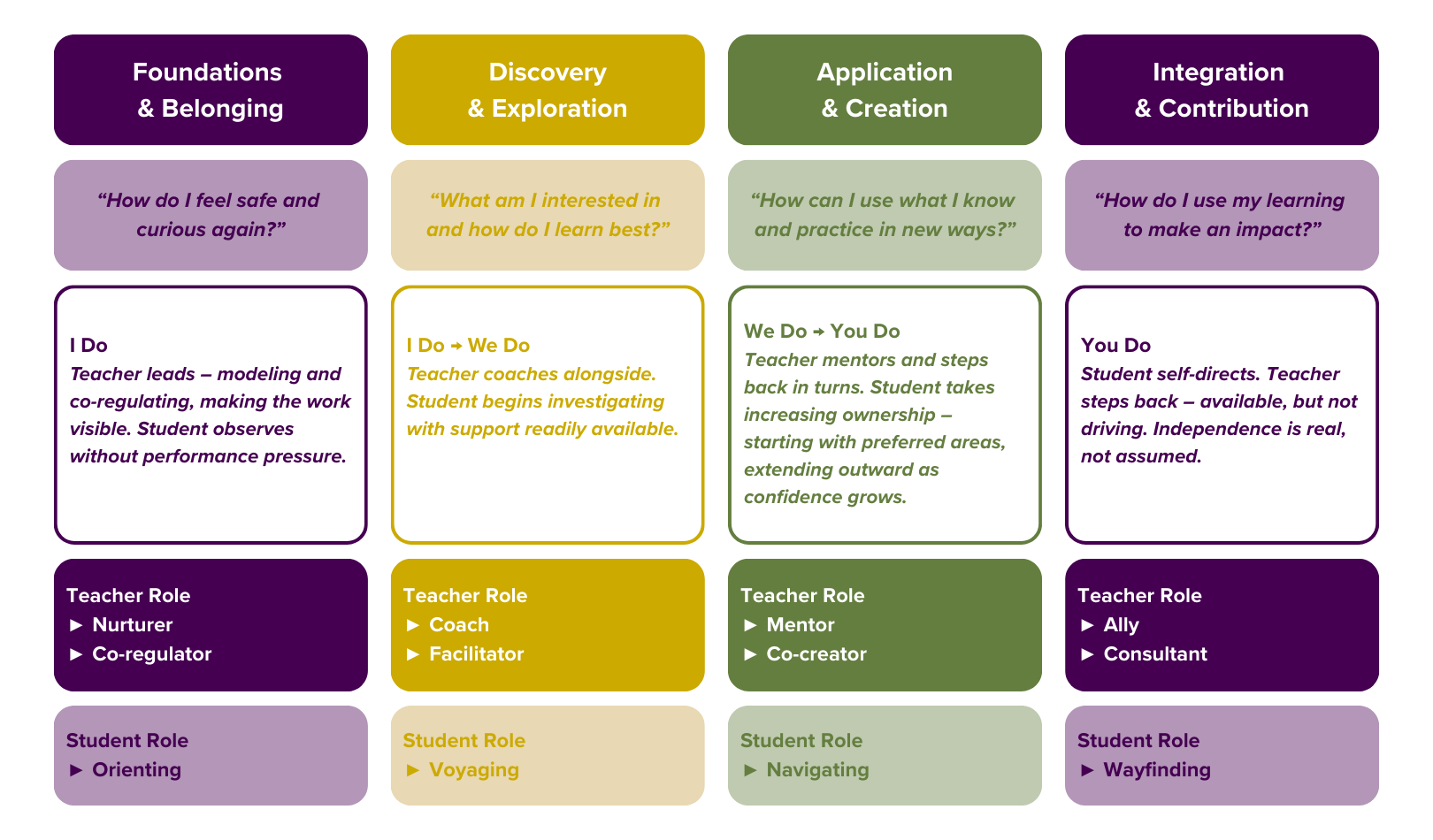
A note on how students move through these phases: the journey isn’t linear, and no phase is permanent. A student can be Navigating academically and Orienting socially. A hard stretch, a transition, or a period of stress can pull a student back toward an earlier phase temporarily — that’s not losing ground, it’s information about what the journey needs right now. And in the You Do phases, we don’t chart the hardest course first. We start from where the student’s confidence already lives — their strengths, their interests — and build outward from there.
I want to name this directly, because it’s the part families sometimes find hardest to hear in the early months: a student who is in survival mode cannot learn at full capacity. This is not a motivation issue. It is neuroscience.
When a person is in a state of stress or perceived threat — and for many of our students, school has historically been a source of both — the brain prioritizes protection over learning. You can’t set a course when you’re just trying to stay afloat. Rebuilding that sense of safety isn’t soft. It’s the prerequisite for everything else.
Research consistently shows that belonging uncertainty — doubt about whether one fits in an academic setting — is linked to significantly worse academic performance over time, and that relatively brief experiences of social belonging can produce improvements that compound across years. The effect is largest for students who had prior reasons to question their fit.
Walton & Cohen, Science, 2011
For twice-exceptional students, belonging uncertainty is often more fraught than for typical learners. Research on gifted students specifically shows that many mask their true abilities and interests to achieve social acceptance — managing how others perceive them in order to fit into peer culture. This identity concealment has its own costs: students who experience stigma related to their giftedness show lower sense of belonging, weaker peer support, and diminished teacher-student relationships compared to gifted peers who don’t experience stigma.
Studies on gifted students’ lived school experience show that many learn early to manage the information others have about them — concealing abilities, masking difference — in order to avoid stigma and maintain social acceptance. Students who experience stigma related to giftedness show significantly lower belonging, weaker peer support, and lower teacher-student relationship quality than gifted peers who do not.
Coleman & Cross, Journal for the Education of the Gifted, 1988; Coleman, Micko & Cross, Journal for the Education of the Gifted, 2015
Many of our students arrive having been simultaneously too much and not enough — too intense, too disorganized, too sensitive, too slow on the things that got measured. We take that history seriously. The Foundations phase of our readiness continuum is built entirely around re-establishing trust and co-regulation before we ask students to take on the vulnerability of genuine learning.
Here is something we’ve learned from working with 2e students specifically: the capacity for hard, effortful work is not unlimited, and pushing through it when a student is already depleted usually makes things worse, not better.
We call this compliance fatigue — the point at which a student has exhausted their bandwidth for tasks that are difficult, uninteresting, or feel disconnected from anything that matters to them. It shows up as avoidance, shutdown, or what can look from the outside like defiance. In most cases, it isn’t any of those things. It’s a student who has nothing left.
When a student shows us they’ve hit their limit, the most effective thing we can do is meet the most important need in front of us — not insist on covering everything on the plan for the day.
This doesn’t mean we avoid hard things or let students stay only in their comfort zone. It means we’re strategic about when we ask for stretch. A student who is already taxed is not in a state where difficult material will stick — so pressing forward is often a pedagogical loss as well as an emotional one. We’d rather return to the hard thing tomorrow, from a better starting point, than win a battle today that damages trust and sets back the work of weeks.
In practice this looks like: prioritizing the most critical learning goal when bandwidth is limited, leaning on strengths and preferred tasks to re-establish engagement before introducing challenge, and building a student’s awareness of their own patterns so they can eventually advocate for what they need themselves.
Self-Determination Theory research shows that environments persistently overriding student autonomy produce compliance that erodes over time — and that recovery of intrinsic motivation requires rebuilding the conditions of trust and agency, not simply increasing external pressure.
Ryan & Deci, American Psychologist, 2000
There is a meaningful difference between unproductive struggle — a student lost, unsupported, reinforcing a story of failure — and productive struggle, where the difficulty is within reach, support is present, and the challenge is the mechanism of growth. The research on this is striking: students who are asked to grapple with a problem before receiving instruction often outperform students who were taught first, even when they feel less confident in the moment.
What sustains students through that kind of challenge — especially students whose relationship with traditional academic rewards has been complicated — is purpose. Not grades. Not approval. A genuine sense that what they’re doing connects to something that matters to them.
Research with over 2,000 adolescents and young adults found that students who connected their learning to a purpose beyond their own success showed greater persistence even in subjects they didn’t enjoy — including on tedious tasks requiring sustained self-regulation. The effect was strongest for students with prior reasons to disengage from achievement motivation — which describes most of our students.
Yeager et al., Journal of Personality and Social Psychology, 2014
I’ve seen this play out over my 20+ years as an educator in ways that still stay with me — students who were nearly unreachable in a traditional classroom who came alive on a wilderness trip, in a makerspace, or leading a project for a real audience. Some talents are born, some are created, and some are discovered on the journey. Our job is to keep building the conditions for that discovery to happen.
––––––––––––––––
Every student who comes to Trillium arrives having navigated a school system that wasn’t designed for them. Some have been at it for years and arrive exhausted, others arrive elated at having found a place that gets them and are raring to experience learning with less restrictions. What we offer isn’t a shortcut or a fix — it’s a different kind of map, and people who know how to read it alongside them.
If your student’s teacher tells you that today they focused on one thing instead of five, that they leaned into a strength before tackling a challenge, or that they let a hard conversation wait until your student had more capacity — that is not a lowered expectation. It is the sequence the research says actually works.
We welcome your questions. That conversation is part of how we find the way forward together.
A note on the research: The studies cited here are real. Most were not conducted specifically with twice-exceptional students — the 2e research base is still developing. The application to 2e learners is supported by strong theoretical alignment, practitioner evidence, and researchers like Susan Baum who have studied this population directly. The Coleman & Cross research was conducted with gifted students and directly addresses the belonging and identity dynamics that 2e students often experience in conventional school settings.